
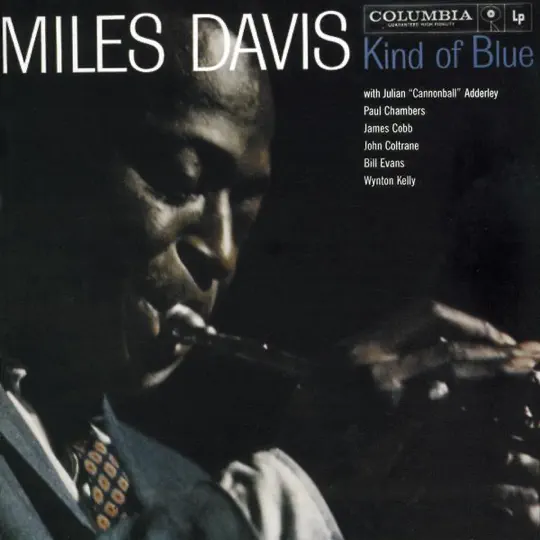
Behind the wheel of my familiar car, steeped in memories of my study-abroad days in the US, I let Miles Davis’s Kind of Blue wash over the interior. The streaming technology of 2026 offers flawless silence and hyper-resolution sound. Yet, my mind drifts to the crackling radio speaker of some anonymous driver back in 1959. What exact color was Miles’s trumpet as it pushed through the narrow bandwidth and the haze of white noise?
As I navigate this frictionless era—flooded with dazzling media and immaculate audio—I am reminded of a time when deprivation actually fueled the imagination. And then, a bitter question catches me off guard: Are jazz and writing now mere museum relics, having lost their purpose in the world?
Blue In Green
Song ∙ Jazz ∙ 1959
When Kind of Blue dropped in 1959, it was a monumental pivot in jazz history. It stripped away complex chord progressions, allowing musicians to drift freely over simple modes. The chilling precision of Bill Evans’s piano and the restrained melancholy of Miles’s trumpet created an overwhelming sense of negative space. But this void gained its unique texture precisely because it was filtered through imperfect mediums. Radio reception was unstable; sounds frequently blurred. To bridge the gaps in the static, the listener’s brain had to work overtime. The moment we filled the silence between the notes with our own memories, the music transformed into a deeply personal narrative. That “transparent texture” wasn’t a gift of high-end audio technology. Rather, it was the spark ignited by the collision of an artist’s desperate will to break through a flawed medium and the listener’s active imagination.
I felt this “friction of imperfection” most viscerally in New Orleans. Unlike the dry, seemingly distilled air of California, the Louisiana air clung to the skin with a raw, heavy dampness. Yet, within that suffocating humidity breathed a strange, intoxicating freedom. Walking down the street with a spicy Bloody Mary in a takeout cup, the improvisations spilling out of nameless late-night clubs felt like real-time inventions and beautiful misunderstandings.
When the wail of a trumpet broke from its intended orbit and made the untamed air even more chaotic, I realized something fundamental. The essence of jazz isn’t perfect playback. It is the raw, uncertain energy born when human emotion collides with an uncontrollable environment. You could pour millions of dollars into building a pristine, dust-free listening room, but it could never replicate the vivid pulse of life awakened by those damp street melodies.
Today, however, the “peril of the pen”—the idea that a single written line could shake a life, or that one must bear the agonizing weight of their own sentences—feels archaic. Communication has become so effortlessly convenient, scattered across countless channels, that our words have grown incredibly light. They no longer create meaningful friction against the minds of others.
If the day comes when human emotions can be digitized into electrical pulses and beamed directly into another’s brain, the weight of literature and music will evaporate entirely. If I could transmit my sorrow or ecstasy to you flawlessly in a single second via a direct neural upload, why would I stay up all night agonizing over clumsy words? Why would anyone blow through brass to vibrate the air? Through the lens of pure efficiency, the painful processes of creation and interpretation are merely expired inefficiencies.
But here lies the absolute divide between human and machine. An emotion injected via an electrical signal is a mere replication. The emotions conveyed through a jazz solo or a struggling essay, however, are the profound artifacts of interpretation and refinement.
Just as jazz completes itself not by avoiding dissonance but by riding the wave of spontaneous “wrong” notes, the essence of our humanity is found in our ability to draw new meaning from friction. The micro-tensions exchanged between the musicians in Kind of Blue are the very soul of jazz’s vitality. Likewise, an article requires us to cage someone’s sprawling thoughts into the narrow confines of vocabulary. The agonizing act of reconstructing those thoughts through the lens of your own experience and senses is the very essence of making the article “yours.” In a world of flawless, transparent signals completely stripped of the need for interpretation, there is no room left for art, nor for the self.
To reclaim the “right to imagine” that ultra-high-definition media has stolen from us, we must intentionally linger in low-resolution spaces. When you think about it, writing is the oldest and most severe form of “lossy compression.” In the process of cramming the boundless universe of our thoughts into the rigid architecture of sentences, massive amounts of data are discarded. That is why an essay you wrote last night feels strangely unfamiliar when you read it the next morning. The “you” of yesterday and the “you” of today are filling the gaps of that lost data with entirely different emotional frequencies.
Writing is a medium structurally embedded with misunderstanding. The moment an author drops the word “happiness” onto a page, they surrender control over the temperature at which it will be read. For some, it will feel like warm sunlight; for others, a distant, aching nostalgia. In the crevices of that misunderstanding, the reader blossoms a landscape the author never even intended. Taking the time to stretch an emotion into lines of struggling prose is a beautiful, necessary inefficiency. It is the definitive proof that we are not mere clusters of data, but humans.
Miles Davis’s “Blue in Green” flows through the car speakers once more. Over the cutting-edge tech of 2026, I paint the analog musings of 1959 and the damp memories of New Orleans. I write this today not to hand you a frictionless, perfect answer. I can only hope that these rough sentences collide with your world, giving rise to an elegant misunderstanding.


