
Theodor Adorno once declared that to write poetry after Auschwitz is barbaric. It was not a provocation so much as a wound: a fundamental doubt about whether beauty can be spoken of at all once humanity has witnessed the depths of what it is capable of doing to itself.
In 2026, that doubt has not been resolved. Somewhere, at this very moment, a family is screaming beneath the rubble of a collapsed building. To sit in a comfortable chair and analyze the rhythms of Beethoven’s Seventh Symphony can feel, under these circumstances, like a luxury the world has not granted us — irresponsible, even dishonest. And yet this discomfort, I would argue, is precisely what allows those of us living through this moment to understand Beethoven’s artistic thinking more deeply. The Seventh was not written in peacetime. It was born from a desperate refusal to let go of beauty while catastrophe raged on every side.
Symphony No. 7 in A Major, Op. 92: I. Poco sostenuto – Vivace
Classical ∙ 1995
When the symphony was first performed in Vienna in December 1813, the occasion was anything but festive. The premiere was a charity concert for soldiers wounded at the Battle of Hanau, one of the bloodiest engagements of the Napoleonic Wars. Men who had lost limbs sat in the audience; on stage, the finest musicians of the age had gathered under the banner of patriotism. What makes the moment still more paradoxical is the condition of the composer himself. By this point Beethoven was already losing his hearing — a catastrophe as devastating for a composer as blindness for a painter, a threat to the very foundation of what he was. War was consuming Europe from without; silence was consuming him from within. Caught in this double siege, he completed the Seventh. It is not a relic of peaceful times. It is a proclamation of survival forged at the sharpest edge of tragedy.
And it is precisely this energy of survival that finds its form in the music.
What sets the Seventh apart is what Wagner famously called the “apotheosis of the dance” — less a compliment than a structural diagnosis. The work is built not on melody but on the absolute primacy of rhythm. After the vast slow introduction to the first movement, a dotted figure in 6/8 time emerges and never lets go, driving the listener forward like a locomotive that cannot stop. Beethoven does not develop his themes so much as hammer them, returning obsessively to a single rhythmic cell until catharsis is the only way out. It is the sound of a will that refuses to yield. As long as the rhythm holds, the march goes on.
The second movement, the Allegretto, deepens this into something altogether more searching. Rather than the slow Adagio convention would have demanded, Beethoven chose a tempo close to walking pace — and what we hear in the repeated dactylic pattern that underpins it (long, short, short) is something unmistakably like the footfall of a vast funeral procession. What the limbless soldiers in the audience heard in it, we can only guess. But as the contrapuntal melody accumulates above those steady footsteps, grief is gradually transfigured into something ceremonial and immense. This is not the music of collapse. It is the music of endurance.
The third movement, Scherzo: Presto, shatters that solemnity in an instant. Its drama lies in the collision between the explosive rhythmic charge of the scherzo itself and the serene trio that interrupts it — twice. The trio, whose melody recalls an Austrian pilgrims’ hymn, sounds like a moment of respite snatched on a battlefield, a breath taken between terrors. But the peace does not hold. The scherzo returns both times without mercy, swallowing the calm whole. The structure is deliberate: a brief rest cannot change the nature of the struggle. Beethoven knew, though, that the fact of it — the rest itself — is what makes it possible to go on.
By the fourth movement, all restraint has been abandoned. Beethoven unleashes the syncopation his contemporaries considered improper and pushes his dynamic markings to fff — a fortissimo beyond fortissimo. In the coda, the low strings generate a basso ostinato, a single figure ground out without end, that drove critics of the day to conclude he had gone mad. It is the sound of a human vitality that has survived its double siege and can now do nothing but explode.
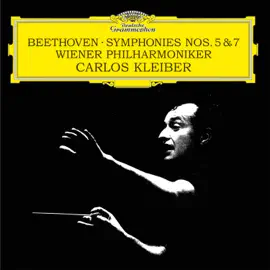
No recording has realized this architecture more completely than Carlos Kleiber’s 1975 account with the Vienna Philharmonic. Kleiber never lets the intricate machinery blur. His baton is both supple and precise, granting every instrument room to breathe individually rather than merging into mass. At the finale’s vertiginous pace, the string bowing stays razor-sharp; the brass retain a transparency that lesser conductors sacrifice for sheer force. What Kleiber makes audible, above all, is the thing Beethoven most wanted heard: liberation through rhythm — survival rendered as sound.
Adorno feared that making art in the shadow of atrocity was a form of barbarism. Beethoven in 1813 answers differently. Losing his hearing while the continent bled around him, he did not stop. The act of making beauty, under those conditions, was itself a form of resistance.
When the last note of the Seventh fades, what remains is a strange silence. The world is no less turbulent; the conflicts are no less real. But the fierce rhythms Beethoven offered to the wounded two hundred years ago carry an unchanged prophecy: that the human will cannot be destroyed, and that when this mad dance finally ends, the peace we long for will come. To refuse to surrender one’s capacity for beauty, even in the crossfire — that, contrary to Adorno’s fear, is not barbarism. It may be the last fragment of peace worth fighting to keep.


