
Not long ago, I was listening to Apple Music — the usual shuffle, half-attentive — when a song stopped me. Something in the voice. A particular quality I couldn’t immediately name, somewhere between warmth and precision, the kind of voice that makes you put down whatever you’re doing. I went to look up the artist.
The artist was AI-generated. No person had ever sung that song.
I stayed with the discomfort for a while, trying to work out exactly what I was feeling. Foolish, partly. But also something more unsettling beneath the embarrassment — a question I couldn’t quite shape. If the voice had genuinely moved me, what exactly had been the problem? What had I lost in that moment of discovery, when nothing about the sound itself had changed? This essay is an attempt to follow that question back to its roots. It goes further than I expected — all the way to the moment someone first held a microphone up to a human mouth and changed what music was allowed to be.
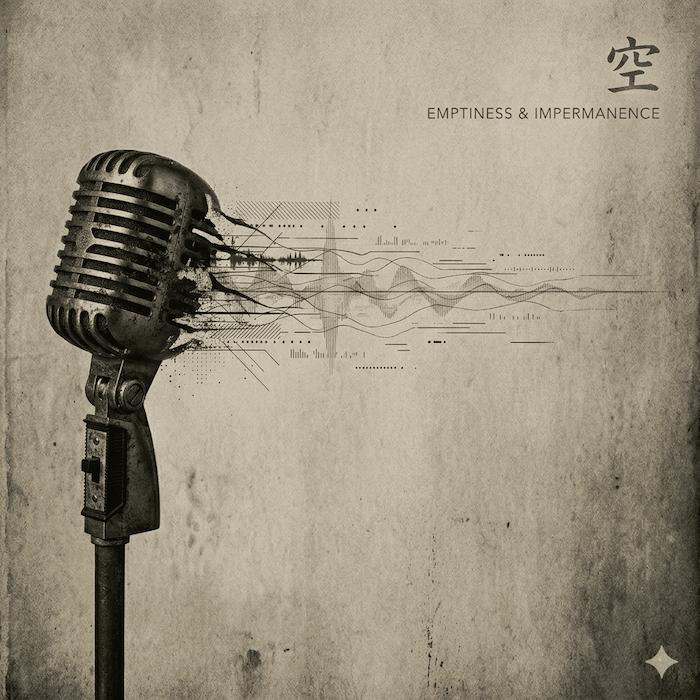
Before amplification, singing was a physical contest. A performer had to drive their voice through walls of orchestral sound and deliver it — bodily, directly — into the ears of the furthest row. Technique mattered enormously, but underneath the technique was something more basic: sheer physical force, a living body spending itself in real time. The microphone rewrote that contract. More than a tool for making sound louder, it became a device for translating the human voice into something else — a signal. Whispers that could never have carried across a room, the soft intake of breath before a lyric, sounds at the very edge of audibility: suddenly these could be captured and broadcast. A whole new style of singing emerged from that possibility. Bing Crosby, Frank Sinatra — voices that sounded like they were meant only for you, close and unhurried, as though the singer were simply talking in your ear. You couldn’t have sung that way before microphones. There would have been no point; no one would have heard it.
And here, almost immediately, a strange thing happens. Because of the microphone, we hear singers more intimately than any pre-amplification audience ever could. And yet we are permanently cut off from the actual sound that person made in that room on that day. What moves us is a copy. Not the voice — the signal. That we can be moved by a copy, that something real happens in us in response to a reproduction — that was perhaps the first sign that technology had begun not just to deliver reality, but to quietly stand in for it.
Which raises a question that turns out to go much deeper than music. We stream a song and don’t hesitate — that’s the artist’s voice, that’s real. But what we’re encountering is a digital file, reconstructed as air pressure in whatever room we happen to be sitting in. The experience is real. The emotion is real. The source is not present. The Earth’s inner core works the same way. No one has ever seen it, touched it, or come within thousands of kilometers of it. We know it exists because of the way seismic waves bend as they travel through the planet — a pattern in data that only makes sense if something dense and solid sits at the center. The core is, in the most precise sense, an inference. We believe in it the way we believe in anything we’ve never directly encountered: because enough independent evidence points to it, and because assuming it’s there keeps working out.
So what do we actually mean when we say something is real? The answer, it turns out, is not I’ve touched it or I’ve seen it myself. It’s closer to: enough things point to it, and acting as if it exists produces reliable results. A corporation has no physical body you could locate. A nation has no nervous system. The bill in your wallet is, at its core, a social agreement about what a piece of paper is worth — one that functions exactly like a fact because enough people treat it as one. These things are as real as anything we can hold. They shape our lives more decisively than most things we can touch. The microphone extended what we could hear. Shared agreement extends what exists. Reality was always, to some degree, a system we consented to believe in — and that consent has always been doing more work than we noticed.
For a long time, though, we had a ready answer to the slight hollowness of a technically flawless AI performance: it hasn’t lived anything. A human singer’s voice carries weight that can’t be manufactured — the weight of a body that ages and gets tired, of years of practice sustained through boredom and occasional pain, of things that actually happened and left a mark you can hear. Think of the specific electricity in a room when a singer steps away from the microphone — no amplification, no safety net — and simply lets a note go on nothing but their own lungs and nerve. What we feel in those moments isn’t admiration for skill. It’s something closer to awe at a mortal creature briefly exceeding what a mortal creature should be able to do. We’re witnessing someone spend something real. That spending was the point. Machines could get the notes right. They couldn’t get the cost right.
But what happens when the technology reaches the story of the cost? What happens when a system has absorbed enough human testimony — enough interviews, journals, late recordings, confessions — that it can generate not just the sound of grief but its movement: the hesitation, the way a voice gets quieter right before it breaks, the texture of something hard-won? We kept moving the line, and the line kept being reached. And I had already felt this, on a small scale, that evening with Apple Music. The sound hadn’t changed. But something had collapsed — some assumption I hadn’t known I was making, one that turned out to be load-bearing. When it gave way, the whole edifice of the experience shifted.
The Heart Sutra, one of Buddhism’s most condensed and radical texts, offers a proposition that resists comfort: Form is emptiness, emptiness is form. What appears solid is, at its core, void. What appears void gives rise to form. This is not consolation. It is not a puzzle with a solution on the other side. It is a declaration that the ground we believed we were standing on was never there to begin with.
The microphone turned a voice into a signal, and we wept at the signal. The algorithm turned suffering into a pattern, and we recognized ourselves in the pattern. Now the technology reaches for the last thing we thought was ours alone — the felt certainty that I know the difference, the gut sense that something is genuinely human — and it is learning to reach that too. What remains? If the signal is indistinguishable from the source, if the story of a life is indistinguishable from a generated approximation of one, if even the feeling these things produce in us can be modeled and delivered on demand — then whose is the emotion we’re having? Is being moved by something my experience, or is it a function running successfully?
There’s no door out of that question. It’s the kind you find yourself returning to anyway — not because you expect to find an answer, but because reaching for the handle still feels, stubbornly, like something only you would do.


